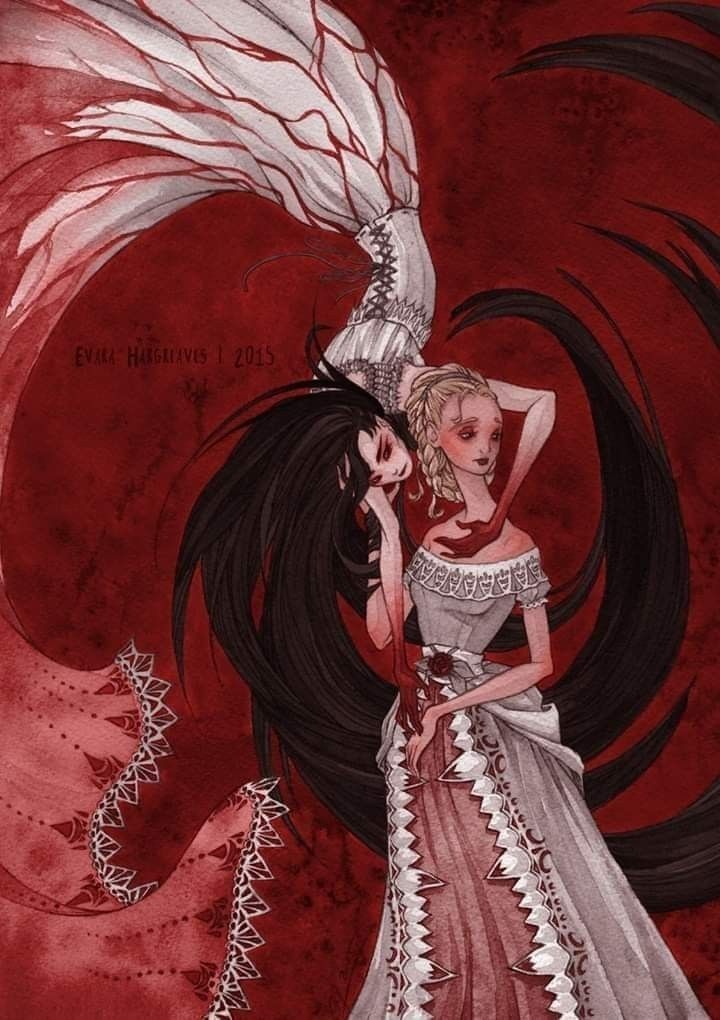
Thunder cracked the night open like a whip. I slept through it all, dead to the world.
She came with hair black as tar and eyes like fresh blood. I never felt her slip into my room, never felt her arms wrap around me. She cradled me and wept. Then she drove her claws straight through my ribs.
My heart came out wet and beating.
Morning came bright and clean, the storm’s fury already fading into memory. As I climbed out of bed and crept down the stairs, I smelled something rank in the air. something metallic. Something that had once been alive.
She was sitting at my kitchen table as if she’d always lived there. At my place waited a silver platter, its domed cover gleaming in the morning light. I sat without question, lifted the lid, grabbed a fork and, for safe measure, a knife.
Together we ate my heart, hands clasped.
Joseph Sheridan Le Fanu is an archaeologist. he goes deep within the earth (the mind), and excavates, extracts, dissects, until there is nothing left. or at least that’s what he did when he wrote Carmilla.
in 1872, le fanu wrote a treatise on the very nature of identity, desire, and consciousness, and then called it a vampire novel. Beneath the queer undertones, the dreamy horror, and the bloodstained gowns lies a story about the terrifying instability of the self.
To read Carmilla is to peer into a mirror that refracts: splitting the self across time, desire, and the gaze of the Other. It is a story about what we must kill off to remain coherent. About what it means to be known, and the violence required to stay intact after.
This is not a tidy essay. It is a meditation, a meandering through psychoanalysis, identity theory, bodily transformation, and the monstrous intimacy between girls. I want to talk about what Carmilla unearthed in me. And I want to begin with the body.
The Violence of Maintaining a Self
From a psychoanalytic lens, Carmilla can be read as a struggle between the ego and the id. Carmilla is not simply an external threat. She emerges from Laura’s unconscious, dreamed before she is ever seen, appearing first in a strange half-memory. She is appetite, instinct, desire. She represents everything Laura’s ego has been keeping in check. She is the id incarnate.
“I had a dream that night that was the beginning of a very strange agony.”
Laura, by contrast, is the ego, desperately trying to impose rationality on an increasingly irrational world.
As Laura and Carmilla grow closer, Laura’s carefully maintained psychological boundaries begin to dissolve. She experiences what can only be described as ego death: her stable sense of self completely disintegrates, and she cannot distinguish where her desires end and Carmilla’s begin.
This is the real horror. Not fangs or blood, but the recognition that this thing we call “self” is a construction so fragile that intimate contact with our deepest desires can shatter it entirely.
The story’s violent conclusion becomes a brutal reassertion of ego control over id. To save Laura’s life, the symbolic representatives of social order—doctors, priests, patriarchal authorities—must literally stake the part of her that sought authentic connection. This violence isn’t incidental; it’s necessary. The story suggests that to maintain what we call sanity or social functionality, we must continuously kill off the parts of ourselves that threaten our constructed sense of unified identity.
But Laura’s survival comes at a tremendous cost. She’s forever changed, left with an emptiness that speaks to what has been lost. To stay “safe,” the ego must deny the id, but this denial brings a kind of living death. The horror lies not in supernatural threat, but in recognizing that maintaining psychological stability requires this ongoing violence against the self.
Psychoanalysis tells us the ego maintains stability by repressing the chaotic forces of the id. But repression is never clean. Carmilla shows what happens when the barrier breaks, when desire returns with teeth. to have a stable ego, we must misrecognize ourselves as unified, and any shattering of that illusion threatens psychic collapse (the death that awaited laura).
Identity as Endless Performance
What does it mean to be the same person over time?
laura begins with what seems like a stable, continuous self. but carmilla’s presence reveals how fragile that continuity actually is. the story asks: if your desires, memories, physical sensations, and even your sense of agency are being altered by another consciousness, are you still the same person? the story seems to say no, as its emphasized how laura is forever changed by her experience with carmilla.
carmilla herself embodies that nightmare of identity persistence. she’s supposedly the same being across centuries, but inhabiting different bodies, different names, different relationships. she’s like theseus’s ship: a philosophical thought experiment about whether identity is tied to consciousness, memory, or physical form. is she the same carmilla if everything material around her changes, if her relationships (the core of ones personal history) dissolve again and again? or is she the same because her vampiric consciousness carries a continuous line of desire and memory? what does her different names being anagrams of each other say about the continuity of her identity? its like asking the reader to watch a self remain “the same” by endlessly rearranging its signs (mircalla, mirllarca, carmilla) . carmilla’s identity, like her many names, survives only by endlessly re-performing itself.
“The fiend who wore her shape… insinuated herself with Bertha under a false name.”
each new name is like some kind of a costume change that inserts her into a fresh social setting so that the “person” endures only while the role convinces its audience. through carmilla, “identity is not an inner essence but a stylised repetition of acts that cite earlier acts until the copy reads as natural” (judith Butler, Gender Trouble (1990)). carmilla survives by continually doing carmilla; there is no hidden, stable core waiting to be found, she never simply is carmilla. I think this somewhat contradicts thw idea of psychological-continuity, that one “remains the same person if enough memories, intentions, and character traits overlap over time.” (derek Parfit, Reasons and Persons (Oxford, 1984)). carmilla retains a thread of desire and selected memories, alters the rest, and the world accepts her as unchanged, proving social recognition, and not some internal core, maintains identity.
the vampire thus illustrates “infinite iterability” (jacques Derrida, “Signature Event Context,” in Margins of Philosophy (Chicago: U of Chicago Press, 1982)): copy the desire line, adjust the back-story, reappear in a new century, and the performance still counts as identity. what endures is not an immutable core but a choreography of signs rearranged for each new audience. identity can never fully coincide with itself because it is always deferred across a chain of different signs and relations. carmilla’s identity persists precisely because it is never fully pinned down. so then does the story suggest that identity, after all, is just a performance? what happens when there is no one watching anymore? i think this is where the theme of loneliness comes into play, but i will explain my thoughts on that later.
Loneliness as the Enemy of Identity
Before we can understand anything else about Carmilla, we need to confront what the story reveals about loneliness: the emotion that is somehow a fundamental threat to existence itself. Loneliness in this narrative creates the conditions for everything that follows. It’s purgatory, limbo, a state of waiting and yearning for the connection that might make life meaningful and affirm one’s very existence.
Think about what loneliness means for identity as performance. If identity requires an audience, if we exist through being seen and recognized, then loneliness becomes the ultimate enemy. How can Carmilla perform her endless iterations of selfhood if there’s no one there to watch? Her centuries of name changes and social reinvention become desperate acts of identity preservation against the void of being unwitnessed.
This is what makes Carmilla’s immortality so horrifying. She’s not just doomed to live forever; she’s doomed to potentially exist forever without an audience, which would mean existing as nothing at all. The anagrammatic nature of her names says something about this as well: her fear of loneliness forces her to become someone else while desperately trying to remain herself.
Think about what those anagrams really represent. carmilla must change her name to continue the performance, to overwrite herself and become a new person for each new audience (because if people recognized her as the same person from centuries ago, she’d be exposed, rejected, left alone). But she can’t bear to completely let go of who she was, so she holds onto the materials, the letters that make up her identity, just rearranged. It’s this compromise: she’ll be someone else to avoid loneliness, but she’ll keep the pieces of herself hidden in plain sight.
Her fear of being alone literally forces her to erase herself over and over again. Each new name is both an act of self-preservation and self-destruction. she survives by becoming someone else, but in doing so, she loses the possibility of ever being truly known as who she actually is. The anagrams become this desperate attempt to have it both ways: to be seen by others (and therefore exist) while somehow still being herself (and therefore continuous). But it’s an impossible bind. the very strategy she uses to avoid loneliness ensures she’ll never be authentically recognized.
Laura’s loneliness is different but equally profound. Before Carmilla arrives, she’s trapped in what can only be described as purgatory: a state of suspended animation where she’s neither fully alive nor completely dead. She exists in her father’s castle surrounded by people who care for her, but there’s this pervasive sense that she’s only going through the motions of living. Her days follow predictable patterns, her relationships remain at surface level, and she moves through her life like someone sleepwalking through their own existence.
“I was not unhappy—this is very sure; but I was not joyous.”
This is loneliness as limbo. Laura has all the trappings of a life, family, comfort, social position, but none of the substance. She’s waiting, though she doesn’t even know what she’s waiting for. There’s this constant sense of incompleteness, as if she’s only half-present in her own life. She’s like someone standing at the edge of existence, neither fully inhabiting her world nor completely absent from it.
What makes Laura’s loneliness heartbreaking is how recognizable it is. Unlike Carmilla’s dramatic centuries of isolation, Laura’s loneliness looks like ordinary life. She has conversations, daily routines, people who love her. But beneath this veneer of normalcy is this profound emptiness. She remains a mystery to herself precisely because no one has ever seen her completely enough to reflect that selfhood back to her.
This is why Carmilla’s arrival is so earth-shattering for Laura. It’s not just that someone new has entered her world—it’s that someone has finally seen her. For the first time, Laura experiences what it feels like to be fully witnessed, completely recognized. The intensity of this recognition is almost unbearable after a lifetime of partial existence. It’s like someone who’s been living in twilight suddenly experiencing full daylight.
The story suggests that loneliness might be the default human condition—that we are fundamentally alone in our consciousness, waiting in this purgatorial state for someone who might make us feel fully alive. But it also reveals that this same loneliness creates such desperate hunger for recognition that we risk destroying the very thing we need to survive.
The Relational Trap
carmilla says that identity might be more so relational rather than individual. laura only discovers who she is through her relationship with carmilla, and as such, her sense of self becomes dependent on this other consciousness. this raises the question: is there actually an essential “laura” underneath all the social roles and relationships? do we only come to know ourselves by being fully seen by another person? laura only truly comes into existence fully through her companionship and connection with carmilla, by being fully seen and in some way loved by carmilla. who is laura, then, without carmilla?
laura’s purgatorial loneliness has made her desperate for any kind of authentic connection, even one that threatens to destroy her. After existing in that liminal space for so long, the possibility of feeling fully real—even if it means losing herself entirely—becomes irresistible. Her loneliness has created the perfect conditions for her own undoing.
This explains the instant, magnetic pull between Laura and Carmilla. They recognize in each other both the potential companionship and the possibility of finally being real. Their loneliness creates the desperate conditions under which total recognition becomes necessary for survival.
“I live in your warm life, and you shall die—die, sweetly die—into mine.”
Carmilla’s predatory behavior isn’t separate from her loneliness—it’s loneliness trying to cure itself through complete merger with another. After centuries of partial existence, she doesn’t want just Laura’s company; she wants total possession, the obliteration of the boundaries that have kept her alone and therefore only partially real.
The only way for an immortal being to remember her own capacity for authentic connection, her own mortality or humanity in some sense, might be through this kind of codependent, deeply obsessive love with another person, even if it means destroying them in the process.
the story seems to ask whether authentic selfhood requires acknowledging our interdependence, being seen and known by another, or violently defending our illusion of separateness and killing off any part of ourselves that threatens the selfhood we know in isolation. we only fully exist when truly seen by another, yet this same recognition threatens our stable sense of self…the real horror could be that authentic selfhood requires this kind of vulnerable, potentially dangerous recognition by another, but our social structures demand we choose safety over authenticity. the face-to-face encounter with the Other is what constitutes subjectivity, but it also calls the self into question.
then, the story becomes some kind of tragic meditation on how we’re caught between two kinds of death: the slow dissolution of never being truly known, or the violent severing of the connections that make us real. laura “survives” but at the cost of returning to that partial existence, now haunted by the knowledge of what fuller being felt like, an ontological incompleteness. sort of like individualism as both necessary and fundamentally impoverishing and true/authentic connection as vulnerability, danger, but also complete fulfillment.
identity in carmilla seems like something unstable, relational, and inherently violent to maintain. it seems to suggest that the self is always co authored and therefore unstable…like you can barricade the borders by staking the monster or dissolve them by merging with it, but either way something vital is lost.
The faustian bargain
All of this brings us to what I believe is the heart of Carmilla: the story is fundamentally about the mortifying ordeal of being known.
This is the Faustian bargain at the center of human existence. True recognition demands radical vulnerability—letting oneself be seen means exposing the parts of the self we keep hidden even from ourselves. When Carmilla looks at Laura, really looks at her, she sees things that Laura didn’t even know were there. The hunger, the desire, the capacity for losing herself completely in another person. This recognition is simultaneously thrilling and terrifying because it reveals aspects of selfhood that the carefully curated ego works so hard to keep hidden.
one thing that makes this recognition so terrifying is the shattering of everything you thought you knew about yourself. When Carmilla truly sees Laura, she doesn’t just witness Laura’s hidden desires; she reveals that Laura’s entire understanding of her own identity was incomplete, perhaps entirely false. The rational, proper young lady discovers she’s capable of abandon, obsession, losing herself entirely in another person. more than self-discovery, this is the violent revelation that the self you’ve been performing might be nothing more than an elaborate costume.
The horror lies in recognizing that authentic recognition strips away both just your defenses and your illusions of self-knowledge. Carmilla doesn’t just see Laura’s repressed desires; she sees the Laura that Laura herself had never encountered. To be truly seen is to discover that you are a stranger to yourself, that the inner landscape you thought you knew has territories you never mapped. The person who sees you completely becomes the author of a version of yourself you didn’t know existed.
Even more terrifying is the loss of authorship over your own story. Laura realizes she was never really in control of her own narrative. Carmilla influences her thoughts and desires, sure, but she proves that Laura’s sense of autonomous selfhood was always an illusion. The terror isn’t just that someone else can shape your desires, but that you discover you were never really shaping them yourself. What you took for free will, rational choice, and personal agency turns out to be something far more contingent and fragile. The bounded, coherent self proves to be a story you told yourself to feel safe.
Perhaps the deepest terror comes from social annihilation. To be authentically seen often means being seen as fundamentally unacceptable to the social order that gives your life meaning. more than just the risk of rejection, once you begin to learn that everything you thought you knew about yourself is untrue, everything you thought you knew about the world becomes untrue as well. Laura’s desires, once fully witnessed and acknowledged, mark her as deviant, dangerous, someone who must be contained or cured. At the same time, they reveal to her that the entire framework through which she understood reality was false. the world is alienated from her and she is alienated from the world. The person who truly sees you might love what they see, but in doing so they shatter your capacity to exist comfortably within the social structures that once gave your life meaning. You face a double exile: society rejects you for what you’ve become, and you find yourself rejecting society for what it demands you remain. The only way to avoid this mutual alienation is to kill off the part of yourself that was finally, authentically seen and to choose social acceptance over self-knowledge.
To experience the fullness of connection, you must risk the dissolution of everything you think you are. Laura’s ego—her sense of being a proper young lady, dutiful daughter, rational person—must be sacrificed to experience authentic recognition. But this sacrifice feels like annihilation because so much of what we call “self” is actually just protective performance, walls we’ve built to keep others at a safe distance.
We’re trapped between two forms of death: the slow dissolution of never being truly known, or the violent dissolution that comes with being completely seen.
What Carmilla reveals is that deep recognition is both ecstasy and horror, both fulfillment and undoing. When Laura finally experiences what it feels like to be completely witnessed by another consciousness, it’s described in terms that are simultaneously spiritual and erotic, beautiful and terrifying. She feels more alive than she’s ever felt, but also as if she’s disappearing entirely.
This explains why humans both crave recognition and fear it. We need others to validate our existence—we literally cannot know who we are without being reflected back to ourselves through another’s perception. But we also fear the objectifying gaze that comes with being truly seen, because that gaze might reveal things about us that shatter our comfortable illusions about who we think we are.
The sexual undertones throughout Carmilla make perfect sense when understood this way. What is being known without some form of intimacy, some form of vulnerability? Sexual intimacy becomes the ultimate metaphor for this complete exposure of self to another. It’s the closest we can come to total recognition, total witnessing, total vulnerability. And intimacy—whether sexual, emotional, or spiritual—is inherently the most dangerous act a human can undertake.
“Love will have its sacrifices. No sacrifice without blood.”
The story suggests that authentic intimacy always involves this risk of ego dissolution. To be truly known by another person, you must be willing to let them see you completely—including the parts of yourself that might be incompatible with your current understanding of who you are. This is why intimate relationships can feel so transformative and so threatening simultaneously. They offer the possibility of finally feeling real, but at the cost of potentially losing the self you thought you knew.
Carmilla presents this bind as fundamentally irresolvable. We cannot survive without recognition, but we cannot survive complete recognition either. The mortifying ordeal of being known remains exactly that—mortifying, necessary, and the closest thing we have to both salvation and destruction.
Desire as the Organizing Principle
We’ve explored identity as performance and identity as being known, but there’s one more crucial piece I’ve been holding onto: desire. Because what anchors identity across all this instability and performance? What makes someone feel like the same person even when everything else about them changes?
The vampire is intrinsically linked to desire, hunger, thirst. And yes, we’ve seen how relational identity and the need to be seen operate in vampire mythology—the tragedy of eternal loneliness, the existential despair that comes with immortality. But vampires also suggest something deeper: that identity is fundamentally rooted in desire, more specifically, an unending hunger that persists across time.
Vampiric identities endure because their core craving endures across centuries, anchoring their sense of self even as bodies, names, and social roles shift and change. Carmilla embodies this perfectly. It’s her unquenchable, endlessly repeated longing that makes her feel like the same being over centuries of existence. Her desire becomes the thread of continuity that holds her identity together through endless transformations.
when I say “desire,” I don’t mean just romantic or sexual longing—though those are certainly part of it. I mean desire as the core organizing principle of identity. Think about those quotes: “Find what you love and let it kill you,” or “Don’t bend; don’t water it down; don’t try to make it logical; don’t edit your own soul according to the fashion. Rather, follow your most intense obsessions mercilessly.”
This is the kind of desire I’m talking about. It’s about fixation, the thing that grips you so fully it orders your entire world around it. It’s what you pursue with relentless passion, what compels you to get out of bed, what keeps you awake at night. It’s the strange pull toward whatever you really love, whatever drives you mad with passion. The vampire makes this “hunger” literal—they quite literally hunger for blood—but the story suggests this applies to all of us. We are all organized around some core craving or longing that gives shape to our sense of self.
“What do you want?” becomes the most dangerous question because answering it honestly might undo us. and for the vampire, immortality is sustained hunger, and hunger is identity.
By contrast, Laura’s encounter with Carmilla’s overwhelming desire completely fractures her own motivational through line. What she wants, who she wants, even her sense of agency become unstable and confused. She can no longer distinguish her own desires from Carmilla’s influence. When the thread of desire snaps or becomes tangled, the illusion of stable, continuous selfhood collapses entirely.
This reveals how precarious identity really is. We think of ourselves as unified, continuous beings, but Carmilla suggests we’re more like an unstable weave of longing, appearance, and recognition. Identity is built on at least three fragile pillars: what we long for, how we are seen, and how deeply we are known. Each pillar is necessary for maintaining coherent selfhood, yet each is capable of completely undoing the self.
“Love is always selfish; the more ardent it is, the more selfish it is.”
Vampires embody all three pillars simultaneously. They persist through their undying hunger, they survive by performing different selves across time, and they yearn for connection deep enough to remember their own humanity. But Laura’s tragedy is precisely how Carmilla’s desire destabilizes each of these aspects of her own identity, showing how tenuous and fragile the self becomes when desire, performance, or recognition falter.
however, these three pillars can work against each other. Laura’s growing desire for Carmilla conflicts with how she’s supposed to be seen (as a proper young lady), and the depth of recognition she craves threatens to destroy the performance that keeps her socially acceptable. The pillars that should support identity end up undermining each other, creating the conditions for total collapse.
Carmilla ultimately shows identity as this unstable weave of longing, appearance, and recognition—each element necessary for coherent selfhood, yet each capable of undoing everything we think we are. The vampire becomes the perfect metaphor for this paradox: a being that persists through endless hunger while constantly risking dissolution through the very connections that hunger demands.
on womanhood
There’s another layer to this story that I find impossible to ignore, and I think the psychoanalytic framework actually supports this reading: Carmilla as a metaphor for the menstrual cycle and the transition to womanhood. The cyclical nature of Carmilla’s appearances, the way she drains Laura’s vitality, the emphasis on blood, Laura’s increasing weakness and “symptoms” that male doctors cannot diagnose…all of this creates a pattern that mirrors the embodied experience of menstruation.
But it’s more than just surface similarities. The way PMS can feel like an invasion of the id into carefully maintained ego structures mirrors exactly what happens between Laura and Carmilla. There’s that sense of your rational, socially acceptable self getting temporarily overtaken by something else—something that wants different things, feels everything more intensely, operates according to different logic entirely.
PMS can make you feel like a stranger to yourself, like some other version of you is emerging that you don’t fully recognize or control. This parallels Laura’s experience perfectly: she describes feeling simultaneously drained and somehow more alive, more aware of her own desires. It’s that contradictory experience of depletion and intensity that comes with hormonal shifts—that strange combination of mania and complete exhaustion, of feeling everything too much while also feeling emptied out.
The timing is crucial here. Laura is on the edge of womanhood when Carmilla arrives. Her symbolic “death” becomes the death of her innocence and her emergence into full womanhood—but it’s a womanhood that must immediately be contained and controlled. The patriarchal response is swift and violent: stakes, doctors, priests, all working to reassert “order” by sealing this new awareness of fluid identity back within acceptable limits.
This fluidity of identity during hormonal cycles parallels perfectly how Carmilla expresses identity as unstable and relational. During these cycles, you can feel like a completely different person, yet you’re still bound to the consequences of that person’s actions. Just like how Carmilla’s presence makes Laura question the boundaries of her selfhood, hormonal shifts genuinely expose how thin the veneer of a stable, rational “self” really is.
They show that the self is not a fixed core but something constantly shifting under internal forces beyond conscious control. The person we think we are can slip so easily. One day you’re the rational, controlled version of yourself, and the next you’re someone who wants different things, reacts differently, feels everything at a different intensity. Yet society expects you to remain consistent, to maintain the same performance of selfhood regardless of these internal fluctuations.
this metaphor connects to the story’s themes about the violence required to maintain stable identity. The menstrual cycle represents a monthly reminder that the body operates according to its own logic, independent of the mind’s attempts at control. It’s a cyclical dissolution of the ego’s carefully maintained boundaries—a monthly encounter with the id that threatens the illusion of rational, unified selfhood.
The male doctors’ inability to diagnose Laura’s symptoms becomes particularly telling in this context. They cannot understand or treat something that falls outside their framework of rational, linear medical understanding. Her symptoms don’t fit their categories because they’re not dealing with a discrete illness but with the fundamental instability of embodied identity itself.
Carmilla suggests that this cyclical instability—this monthly reminder that we are not fully in control of our own bodies and desires—represents a threat to patriarchal systems that depend on stable, controllable subjects. The violent ending becomes not just the staking of a vampire, but the violent suppression of feminine cyclical time in favor of linear, patriarchal order.
conclusion
Carmilla forces us to confront uncomfortable truths: that identity is both necessary and fundamentally unstable, that authentic connection offers fulfillment at the cost of psychological safety, and that the self we think we know is always more fragile than we dare to admit. The real horror isn’t that monsters exist, but that we ourselves might be the monsters we must stake to survive—and that this survival comes at the cost of everything that makes us fully human.
In the end, Le Fanu offers no easy resolution to the paradox he presents. Instead, he leaves us with the recognition that the mortifying ordeal of being known remains exactly that—mortifying, necessary, and utterly human. The story suggests that authentic selfhood might require acknowledging our fundamental interdependence, even as our social structures demand we choose safety over authenticity.
What does it cost to exist? carmilla says blood, flesh, bones, and everything that comes with.
Leave a Reply