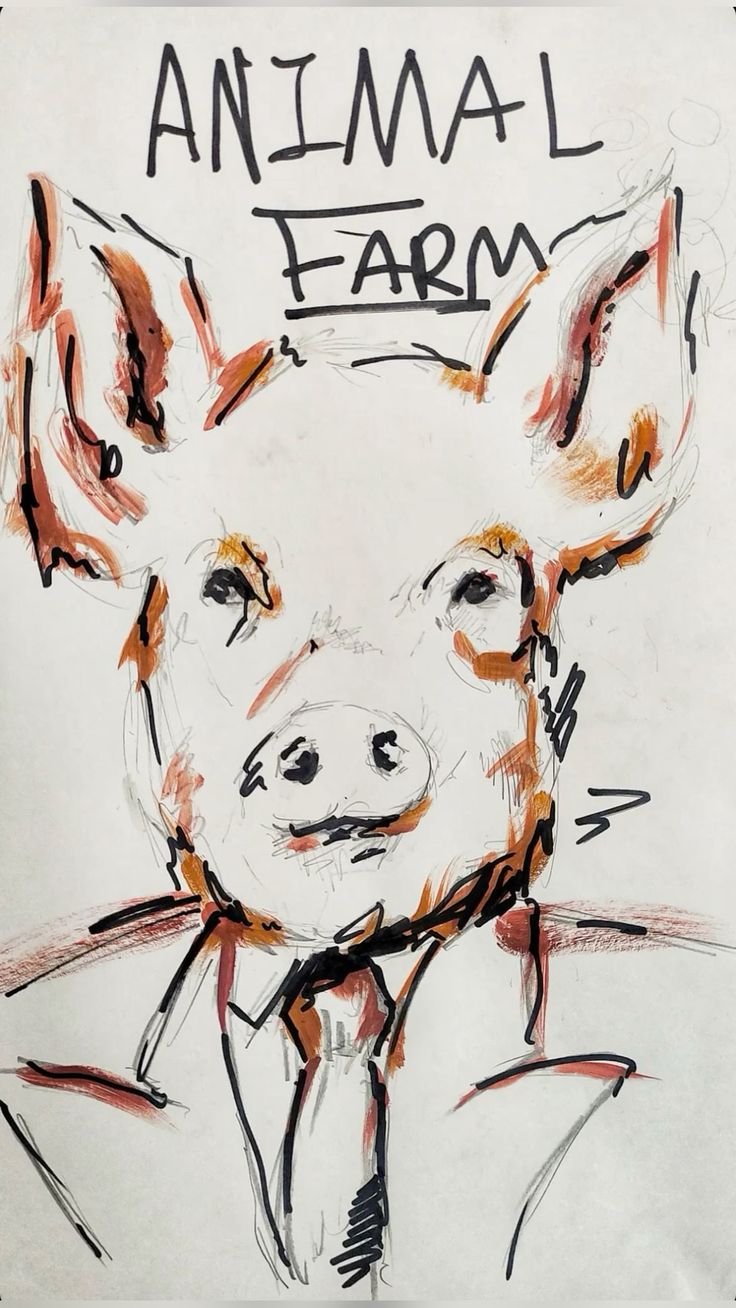
man, it was really, really hard to rate this story.
i mean, a lot of things can go into rating a story. like, what constitutes a rating? is it personal enjoyment? how well the story set out to do what it was trying to do? is it plot, characterization, depth of themes? it really is hard to say, and i think for me, it changes with each new work i read (just look at my brave new world review, for instance…).
so…i gave animal farm 3 stars. this is a complicated rating that i will try to explain well, as it is a mix (for me) of personal taste, what i actually took away from the work, and how well it did what it was trying to do.
i think if i were rating this work purely off of how well it did what it was trying to do, i would hands down have to give it 4-5 stars. it did what it was trying to do extremely well. it satirized the ussr, it warned the world of the easy ways revolutions can be overtaken by bad actors with bad intentions, and it called stalin a pig while doing it. it made this lesson incredibly easy to understand (as is the nature of satire), and i think in some ways it tried to avoid blaming the working class for their own oppression (although, in some ways it failed to do this. which is why i don’t think i would give it fully 5 stars in this case). i do think orwell genuinely tried to craft something urgent and accessible. there’s something bold in trying to smuggle revolutionary cynicism into a children’s fable, and make it unforgettable while doing so.
unfortunately, i’m not basing this work purely off of how well it did what it set out to do. there are a few other things i’m factoring in, which caused it to lose 1-2 stars from me.
let’s first talk about what the true intention of this work was and how that affected the rest of the storytelling process, so it doesn’t seem like i’m judging it unfairly.
i think orwell’s largest goal in writing this was a big fuck-you to the soviet union. he wanted to call them hypocrites, oppressors, and no better than pigs. and he wanted to write it as a children’s story to make that fuck-you even sweeter. because of this, animal farm isn’t…well, it isn’t really a story. it’s more so a fable, an allegory, maybe a snapshot in history. as such, most storytelling metrics anyone would normally go by cannot be applied here.
i cannot in good faith evaluate the depth of characterization into my rating, because depth of character does not exist in this work. it was never going to exist in this work, because it’s not about the characters. it’s about the message.
likewise, i cannot in good faith evaluate the plot into my rating, because plot is thin by design in this work. it was never going to be a huge part of this work, because it’s not about the plot. it’s about the message. (let me just say, plot wise, i rated metamorphosis a 4.5. so i’m really not a stickler about plot!)
i cannot even evaluate the cleverness of the premise. the premise is “fuck you stalin”. that’s the premise.
actually, on second thought…maybe i could evaluate the premise…should i change my rating to 3.5 stars?
regardless, most things that make up a riveting story in the modern sense cannot be applied here. that’s not the point, and taking that into account cannot be done in good faith. that being said, because i cannot take these things into account to take away points, i also cannot take them into account to give back points. many of the things i will say following this could have been offset by some of these things that i cannot take into account being stronger. it’s harder for a story to rise above “good” when you’re deliberately cutting out the elements that might’ve elevated it (character, plot, mystery, beauty). this means that the things that do exist within the work, and that can actually be evaluated, have to be damn amazing in order for it to be more than just “good”!
i’m going to start with prose. the prose itself was pretty stilted and dry. it did its job, but it wasn’t enrapturing like orwell’s prose was in 1984. of course, i understand that this is intentional, as animal farm is meant to be written and read like a children’s story. still, i took off points for it. dry prose doesn’t have to be lifeless. take something like steinbeck. his writing is simple, but it breathes. it aches.
the writing in animal farm feels functional rather than beautiful. sentences like “All the animals were now present except Moses, the tame raven, who slept on a perch behind the back door” or “The work of teaching and organizing the others fell naturally upon the pigs” get the job done but lack any real texture or rhythm. there’s no lingering on moments, no psychological depth in the descriptions, no sense that language itself is being used as an artistic tool.
nevermind steinbeck, compare this to jackson’s carefully controlled sentences in “the lottery” that build dread through their very ordinariness and precision. i may have rated the lottery a tad bit low, but trust me when i tell you it was not because of the prose (i was absolutely floored by it).
both writers understand that the language itself needs to do work beyond just conveying information, it needs to create atmosphere, unease, moral complexity. orwell’s functional approach serves the allegory, but it doesn’t serve my personal reading experience. orwell’s prose here doesn’t breathe. it instructs.
next, the themes. the themes in this story are good. they are worthy of 3 stars. this is a satire, so they are incredibly in-your-face, but that’s the point. and i do think orwell handled the satire well.
beyond the stalin critique, orwell is exploring how propaganda works (squealer’s constant rewriting of history), how power corrupts even well-intentioned leaders (napoleon’s gradual transformation), how revolutions can be co-opted by opportunists, and how education and literacy become tools of oppression when controlled by the ruling class. there’s also the broader point about how capitalism dressed up as communism or socialism is still capitalism. the animals’ revolt genuinely begins as a communist movement, but by the end the farm has literally reverted back to “manor farm” with the pigs indistinguishable from the humans they once fought against (right back into capitalism, baby ;)).
these are all genuinely important and poignant themes that extend far beyond just the ussr. the way revolutionary movements can be hijacked by bad actors is something we see throughout history and across political systems. the mechanisms of propaganda and how they work on people, the constant rewriting of history, the manipulation of language, the way slogans replace critical thinking, these are universal tools of oppression that aren’t limited to any one political system. orwell’s insight into how language itself becomes a weapon is absolutely brilliant. when squealer transforms “all animals are equal” into “all animals are equal, but some animals are more equal than others,” he’s showing how those in power can make contradictions seem logical simply by controlling the narrative.
the theme about education as a tool of control is incredibly well done. the way the pigs monopolize literacy and use it to maintain their power illuminates even ongoing struggles about who gets access to information and knowledge. when benjamin can read but chooses not to, when the other animals are kept functionally illiterate, orwell is showing how ignorance can be both imposed and chosen, and how both serve the interests of those in power. or the insight that those who gain power through revolution can quickly become indistinguishable from those they overthrew is deeply cynical but often true. the final scene where the animals look from pig to man and cannot tell the difference is absolutely haunting in its implications about the cyclical nature of oppression.
orwell handles all of these themes expertly within the constraints of allegory and satire. he makes complex political ideas accessible without dumbing them down, and he creates memorable images that stick with you long after reading. the problem isn’t that these themes are unimportant. they’re incredibly important. in fact, there is no problem at all. there’s a reason this story gets taught in schools. orwell almost engraves the mechanics of propaganda in animal farm. the slogans, the gaslighting, the slow creep of authoritarian control, they’re all mapped out with stunning precision and accuracy. if you’re encountering these themes for the first time, it can be world-altering. life-changing, even.
they’re good. the themes are good.
the themes are good but they just aren’t great.
i think this can be a not uncommon pit one falls into when they write an allegory, right? well, maybe not all allegories, but definitely this type of straightforward political allegory. like Jackson’s the lottery is also some kind of political allegory, and the (tertiary) themes are there but they just aren’t wow! awe-inspiring, amazing.
most allegorys demands clarity. it can sometimes requires flattening complexity into symbols. it certainly did so in animal farm. so boxer isn’t a person, he’s a type. napoleon isn’t a character, he’s a stand-in. and when everyone is a metaphor, there’s no room for contradiction or growth. without contradiction, there’s no real humanity. this isn’t necessarily a bad thing in stories in general. it can work, but gets a bit dicey when we’re talking sociopolitical messaging and class consciousness. To be clear, I’m not anti-caricature; I’m wary of this caricature’s real-world implications.
i don’t think all allegories are doomed to this fate. many manage to preserve dissonance even while making their point. depth is one of the most moving things about literature to me. whether that’s through dissonance, beautiful language, complex characters, or themes that reveal new facets the more you think about them. great themes often come from tension, confusion, the gray areas. this specific kind of allegory orwell is doing, while necessary, shaves those layers off. it trades ambiguity for precision, and in doing so, it sometimes trades resonance for message. that’s why, even though i admire animal farm, even though i know that this is intentional, it doesn’t haunt me. because fables conclude. its hard to linger in a conclusion.
generally, i am more taken with works that leave me wondering or that transform me. ones that leave me questioning, wanting, thinking differently than when i first started. i like works that offer layers to peel back or new angles to consider. i like works that resist easy interpretation and leave you genuinely unsettled or questioning. these are books that present situations and characters that you can’t easily categorize, that force you to grapple with questions that don’t have clean answers. some allegories adhere to this…
animal farm, however, is a puzzle with a clear solution. once you understand the historical allegory, everything clicks into place. it’s effective as political commentary, but it doesn’t haunt you the way truly great literature does.
this is by design on orwell’s part. and that is a-okay, the themes are still good. they just aren’t great…
ok maybe i lied a little. i do think the themes could be great for someone. unfortunately, that someone is not me. i think if i had read this in middle school or maybe even early high school, i would’ve been absolutely taken by these themes. i would’ve rated it much higher. however 22 year old niah has just read too much, lived too much, reflected too much and learned too much for these themes to be groundbreaking to her anymore. because i also like works that open my eyes to something, that peel back all of the muck until i can’t look away anymore. but i’m just a bit too familiar with everything that animal farm is trying to say.
And here’s the thing. when themes aren’t revelatory to me anymore, when I’ve already grappled with these ideas extensively, that’s when I need other elements to carry the work into greatness. Maybe it’s beautiful prose that makes familiar ideas feel fresh, or complex characterization that adds new layers, or that haunting ambiguity that forces me to reconsider what I thought I knew. It’s not that I prefer ambiguous works on principle. but when the thematic punch isn’t there for me personally, something else needs to fill that space to make the work transcendent rather than just effective.
this work did not tell me anything i didn’t already know, it didn’t expose something hidden within me or hidden in the world. and without the gripping prose, without the depth of character, without the riveting plot, without the awe-inspiring-heart-beating-out-of-chest themes, without any sort of dissonance, tension, ambiguity…the work is good. but it isn’t great.
“but niah!” you say to me, an expression of confusion and maybe a little anger written within the lines of your face. “why not at least 4 stars? 3.5?”
“well, person reading this,” i answer you, “i’m getting to it.”
there is one theme in this work that bothers me to my core. it’s the reason why i rated this 3 stars instead of 3.5. i don’t think it was intentional on orwell’s part. it may have come from the very fact that this is a very simplified story. it’s supposed to be like a children’s story, so some things must be simplified in order to make accessible or at the very least to not make so horrific.
the way orwell portrays the working class in animal farm truly disgusts me.
“but niah,” you say, a bit more urgently this time. “the working class isn’t the point. it’s the pigs! the ruling class! doesn’t that count for something?”
it counts. and that’s why this rating is a 3 and not a 2.5. still, in some way, isn’t the working class still a little bit the point? this work quite clearly discusses the ways in which revolution can be co-opted, doesn’t the working class have a role in that? orwell seems to think they have a role. and the role orwell ascribes to the working class is. well.
stupid.
orwell portrays the working class as impossibly stupid. the animals (that aren’t pigs) literally can’t even read. and it’s not that just that they can’t read. it is that they literally have no aptitude or ability for reading. the working class is stupid. they are oafs, easily manipulated, and ultimately useless. the few voices of dissent to napoleon’s rule are literally other pigs. the working class is so dumb, they can’t even realize they’re being exploited.
when the commandments are literally changed on the barn wall, painted over in the middle of the night, the animals just accept squealer’s gaslighting explanations about their “faulty memories.” when boxer, the most loyal and hardworking animal, is sold to the glue factory, the other animals watch his removal truck drive away and believe squealer’s obvious lies about it being a veterinary van. these are moments of political manipulation, sure. but they’re also moments that suggest the working class is fundamentally incapable of critical thinking.
what’s really galling is how orwell presents this. the animals aren’t shown as lacking education or opportunity, they’re shown as lacking basic intelligence. clover “could read fairly well” but somehow never thinks to question what she’s reading. benjamin can read perfectly well but chooses to remain silent, which almost makes it worse – the one working-class character with intelligence becomes complicit through inaction. the sheep literally cannot think beyond repeating slogans. boxer’s response to every crisis is “i will work harder” and “napoleon is always right” – he’s portrayed as physically powerful but mentally childlike.
his portrayal becomes even more problematic when you remember that orwell himself was an etonian who went to prep school and served as an imperial police officer. his experience with the working class was largely observational, from a position of class privilege. the way he writes these characters suggests someone who has never actually been in the position of economic desperation, of working multiple jobs just to survive, of having to choose between educating yourself and feeding your family. there’s no understanding of how systemic oppression actually works – how it’s not stupidity that keeps people oppressed, but lack of resources, time, energy, and access.
there’s a world of difference between being kept illiterate and being inherently unintelligent. orwell collapses the two. and that collapse, that conflation of ignorance with mental incapacity, is what bothers me. the story suggests the animals never could read, even if given the chance. their failure is intrinsic. and that, to me, feels more like classist caricature than social critique. worse still, it subtly shifts blame away from the ruling class and onto the oppressed themselves. if the workers are too stupid to see what’s happening, then maybe they deserve to be ruled. and that’s a dangerous implication, even if it’s unintentional. it reinforces the elitist notion that only the “smart” deserve freedom…while the rest are fated to be ruled.
i think this sort of framing coming from some aristocratic rich guy is really quite disturbing. it is also just way too simplified, but i truly do believe that this level of misunderstanding and simplification could only come from some rich person who has never been in the place that the working class has been in.
orwell could have made his point about totalitarian manipulation without suggesting that the working class is simply too stupid to resist their oppression. he could have shown how propaganda works on intelligent people, how economic desperation makes people vulnerable to exploitation, how the ruling class deliberately keeps education and resources away from workers. instead, he chose to portray the working class as inherently limited in their capacity for critical thinking, which feels both classist and historically inaccurate.
maybe orwell didn’t mean to insult the working class. maybe he thought showing their manipulation would inspire sympathy. but intent doesn’t erase impact.
and let’s be honest– if every meaningful voice of dissent in your revolution is a pig…what does that say about who you think deserves power?
“niah,” you say, this time with irritation much clearer in your eyes and tone. “what about good faith? i thought this was supposed to be a good faith review? doesn’t every issue you have with this work stem from the fact that it’s a fable-like satirical political allegory?”
my, my, dear reader. how bold you’ve become.
to this question, i will say that i’m not sure.
i do believe that i like allegories. i was a child once. i thoroughly enjoyed the three little pigs, *insert more here*. then again, those work don’t deal with such specific themes. their themes are more universal. and they certainly aren’t political.
one satirical and allegorical work i truly love is the ones who walk away from omelas. i mean, le guin hits every metric in the book. prose? my goodness, the voice! the character! themes? they are so rich, so so urgent, and only get more and more poignant the more you think deeper about it. omelas is an onion. it has so many layers. its a story that peers deeply at you, the reader, and it’s a gaze that you simply can’t look away from. Same clarity of message as animal farm, plus space for contradiction and unease.
but…omelas is a bit different from animal farm. it’s not written as a sort of fable, for one. for two, it’s much less specific. it’s political, but in a more distant way and abstract way. omelas isn’t concerned with the same thing animal farm is concerned with. it’s concerned with something a little less immediate, a little less concrete.
so maybe the answer to your question, my friend, is that i do like satirical allegories. however, i’m not too crazy about fable-like satirical political allegories that simplify topics that are just too complex to be simplified in order to make a clear point.
but man, now that you’ve brought it up, is this review in good faith? i mean, orwell did what he set out to do. all this i’ve written about “themes that haunt you” and “intentional prose”, what of it? he wasn’t concerned with that when he wrote this…he wasn’t trying to write something that would leave one speechless. he was trying to write a story about a specific moment in time to make a point, that still somehow ended up having themes that resonate throughout history.
…yet it still didn’t fully work for me…
is it his fault it didn’t work for me, specifically? that what i look for when i read a story is just something he decided not to provide this time? it’s not like he misstepped. it’s not like there was an actual issue with his narrative. he wrote a political allegory and it was well crafted, all things considered, within the constraints of the genre…
well, i did say if i was rating this on whether or not the book achieved what it was trying to achieve i’d give it 4-5 stars, right? i covered my bases…i think i’m in the “good-faith” green zone for now…
you sigh dejectedly, now having realized there is no hope in convincing me. “So why not 2½ stars? Why not 4?”
Because it’s still historically important, wickedly pointed, and occasionally funny. Because the satire does hit. Because (despite myself) that final line about “some animals are more equal than others” still works. animal farm is tightly structured, which works in its favor. no scene is wasted, no image misplaced. you get the rise and fall of an entire revolution in under 150 pages, and that’s no small feat.
i found myself invested in the lives of these barn animals. i cried when boxer was taken to his death. i audibly gasped when napoleon ousted snowball. i felt these things.the line “The creatures outside looked from pig to man, and from man to pig, and from pig to man again; but already it was impossible to say which was which” hit me right where it was meant to. it was the entire point of the novel, it’s thesis distilled into one line, and it did its job well. and i think that says something, that even stripped of beauty, complexity, and character, orwell still managed to provoke emotion. maybe it was the horror of recognition. maybe it was the simplicity that made the betrayal feel so raw. maybe the animals are types, but types drawn from something real, something we’ve all seen: the naive loyalist, the manipulative speaker, the silent observer, the power-hungry leader. All that keeps the floor at 3. But the ceiling stays there too.
okay this is the last part of this review where i’m second guessing myself, i promise:
maybe i’m being unfair here.
even after all this, I still feel conflicted. Because I do recognize the necessity of a work like this, just like I do with something like Uncle Tom’s Cabin (despite the racism) or To Kill a Mockingbird. These are books that mattered, that cracked something open in the public consciousness.
maybe i’m asking animal farm to be something it was never supposed to be. because what if we need another book like this tomorrow? what if fascism creeps in again and we need someone to write the barnyard animal version so people can actually see it happening?
literature isn’t always about dissonance and the human condition. sometimes it’s about taking a stand. sometimes it’s about making a point so clear that even someone who’s never thought about politics can understand it. orwell could have written an essay about the dangers of stalinism, but who would have read it? who would have remembered it? instead, we get this sticky, unforgettable image of pigs becoming indistinguishable from humans, and that works on people in a way academic analysis doesn’t.
maybe some books are supposed to be tools for their time rather than timeless art. maybe the blunt instrument is just as necessary as the subtle, haunting novel. maybe there’s room for both: the literature that makes you question everything and the literature that makes you see what’s right in front of you.
even knowing all that, even respecting what animal farm accomplished…it still didn’t transcend its moment for me. ultimately, the problem may be that i already see what is right in front of me. and i guess that’s okay too. It didn’t haunt me. But maybe it was never meant to haunt, never meant to transform, but only to wake and instruct.
so yeah. it’s a classic. it’s important. it most likely deserves 5 stars in a history class. classics aren’t always revelations. They’re scaffolding. And Animal Farm, for all its importance, is just that: solid, instructive, even moving. But not transcendent. A good book. Not a great one (to me). and that’s okay.
also just to note: i don’t think this book is anti-communist or anti-socialist, but more so anti-fascism and anti-totalitarian government (and especially anti-stalin/ussr). i read this book with that framing/perspective in mind, and i think in some ways it is also anti-capitalist as well. i don’t think the ussr was real communism or real socialism, but instead some perverted and fascistic version of it, and i think that is also part of the message of this story.
tldr; Animal Farm succeeds at its political messaging (hence not a lower rating) but doesn’t have the prose beauty or thematic complexity to push it higher. other narrative metrics like characters or plot are negligent in this story and cannot be taken into account. The working-class portrayal issue also somewhat keeps it from being higher, however the effective and poignant political satire keeps it from being lower (and earns it most of its points).
Leave a Reply